
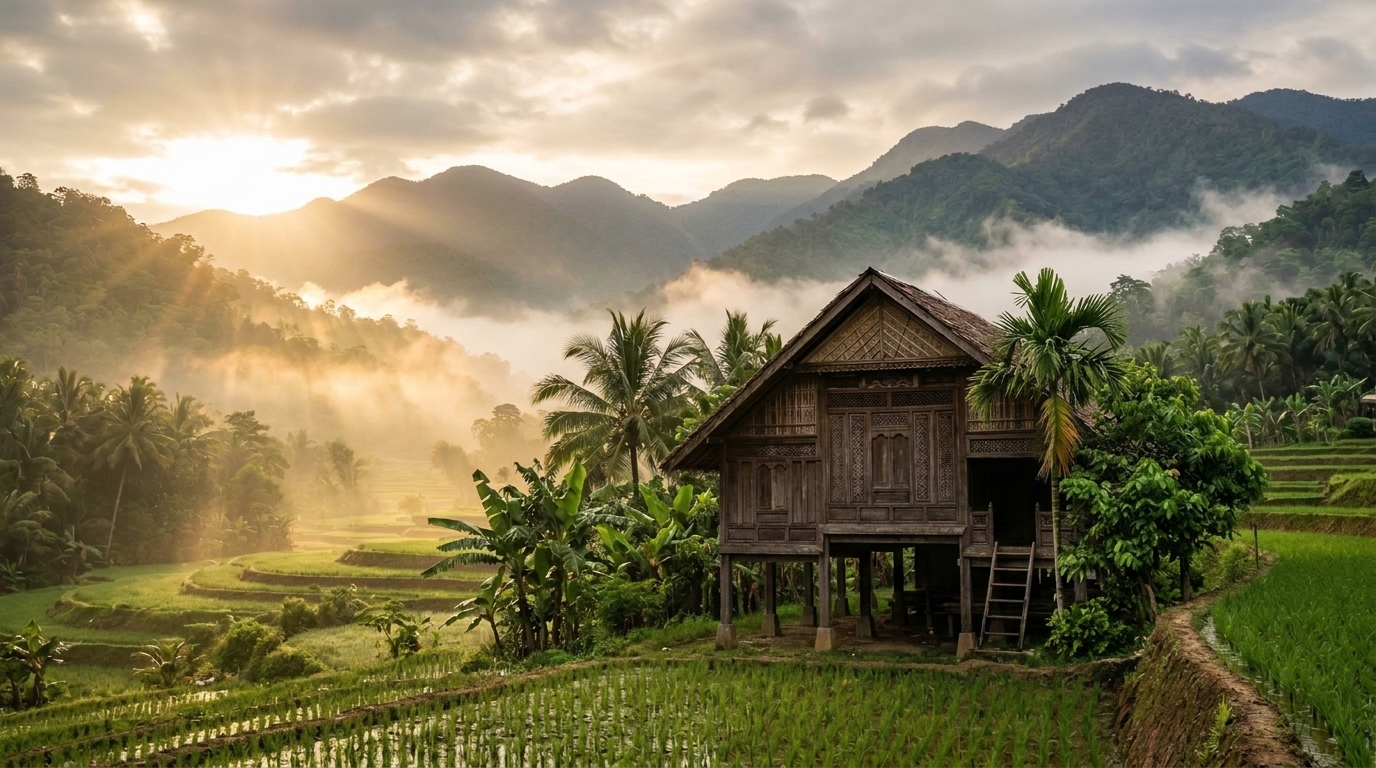
Morning mist has barely lifted from the rugged ridge lines of Tangse when copper-gold dawn light breaks across the Malacca Strait on the shores of Sigli. In the rural village compounds of Ceurih and Garot, the first sound greeting the new day is not industrial machinery, but a rhythmic, melodic cadence: tuk, tak, tuk, tak. It is the sound of Pidie women wielding flat iron mallets, hammering fire-roasted melinjo nuts into wafer-thin crisps renowned across the Indonesian archipelago.
A few miles southward in the bustling junction of Keude Beureunuen, steam billows from brass pouring kettles in roadside timber coffee halls. The intoxicating fragrance of mountain-grown Tangse Robusta beans fills the morning air. Across aged marble tables, locals converse with spirited banter: trading 99% pure gold, discussing spice yields, and checking in with kin managing textile stores in Jakarta’s grand markets or overseas trading hubs.
To passing travelers, Pidie Regency might appear as a sweeping coastal agricultural plain bordered by volcanic peaks. But to those who linger, savor its coffee, and listen to the murmurs of its villages, Pidie reveals itself as a living epic. A homeland where ancient maritime glory, an intrepid merchant diaspora, steadfast dayah scholarship, and unpretentious dialect converge into an enduring cultural soul.
I. Ancient Pedir: The Maritime Pepper Crossroads of the Malacca Strait
Long before modern administration demarcated these sub-districts, Pidie’s coastline was recorded in golden letters across world navigational charts as the sovereign Kingdom of Pedir.
During the late 15th and early 16th centuries, Portuguese apothecary and chronicler Tomé Pires sailed through Southeast Asian waters and wrote in his seminal Suma Oriental (1512–1515):
“Pedir is a prosperous and sovereign realm. Annually its harbors receive junks from China, merchant galleons from Gujarat, Coromandel, Bengal, Arabia, and Venice. Here the finest black pepper in the world is gathered, rice harvests are bountiful, and fine silk is woven with great artistry...”
Black pepper cultivated in the fertile foothills of Pidie was black gold, exported across the Indian Ocean toward the Red Sea and European dining tables. Today, remnants of that cosmopolitan maritime grandeur remain tangible at coastal Kuala Batee and among ancient carved funerary gravestones (the Plang Kling style) scattered across Muara Tiga and Kembang Tanjong.
II. Stories Behind the Place Names: Toponyms and Memory
Every corner of Pidie carries history etched into its name:
- Sigli (The Coastal Gateway) — Local oral lore traces the name to Si-Glee (the watch-hill lookout) and Sikureung Lee (the confluence of nine freshwater streams meeting the sea), where ancient harbor masters monitored incoming merchant vessels.
- Tangse (The Highland Cloud Valley) — Rising over 600 meters above sea level, Tangse denotes an amphitheater-like natural stone basin catching alpine rains, historically serving as a crucial caravan pass for high-country timber and coffee traders.
- Mila & Tiro (Land of Sanctuaries and Warriors) — Mila was founded by early civil architects who developed intricate canal systems, while Tiro achieved worldwide renown as the ancestral seat of the heroic Teungku Chik di Tiro scholarly dynasty.
- Laweung (The Ancient Karst Harbor) — Located on the northwestern promontory, Laweung refers to natural limestone headlands and sheltered coves where fishermen traditionally dropped anchor (meulaweung) when westerly storms swept the Malacca Strait.
III. Pidie and the Merchant Diaspora: The Philosophy of Returning Home
The defining cultural trait of Pidie is its deep-seated tradition of circular migration (jak mita raseuki). Why is voyaging so deeply ingrained in the Pidie psyche?
The answer lies in geography and demographic balance. While Pidie's alluvial plains are intensely fertile, arable land is bounded by sea and mountain. As generations grew, splitting heritage rice paddies risked collective impoverishment. Hence arose an unwritten rite of passage: young adults venture into the wider world to pioneer commerce.
“Ulee gle meugisa u laot, ureung Pidie meugisa u gampong.”
(As mountain rivers inexorably flow to the ocean, so does the traveler from Pidie: however far they wander, their soul always returns to uplift their ancestral village).
With integrity, commercial acumen, and tireless grit, Pidie merchants built formidable networks across Sumatra, Java, and the Malay Peninsula. Remittances sent back home built soaring village prayer halls (meunasah), endowed rural religious schools, and funded communal harvest celebrations.
IV. Market Rhythms: The Symphony of Beureunuen and Melinjo Heritage
At sunrise, Beureunuen Market hums with trade. It is the economic heartbeat of eastern Aceh, famous for its grand jewelry arcade where 99% gold (manyam meuh) serves as the trusted community hedge and wedding dowry. Nearby, highland farmers unroll fresh produce while rural women in Delima and Ceurih maintain the artisanal mastery of emping melinjo.
V. Echoes of Islamic Scholarship: Dayah Sanctuaries and Moral Anchors
Pidie has long been celebrated as Aceh's cradle of Islamic scholarship. Its towering figure, Teungku Chik di Tiro (Muhammad Saman, 1836–1891), established the renowned Dayah Tiro before uniting moral spiritual resistance through the epic poetry of Hikayat Prang Sabi. Today, hundreds of rural dayah schools continue educating students in classical jurisprudence, Arabic grammar, and ethical philosophy.
VI. Custom, Meunasah, and Communal Artistry
Village harmony centers around the Meunasah—a communal timber stilt pavilion serving as prayer sanctuary, town hall, and cultural school. Rites such as Peusijuek (spiritual blessing of cooling waters and sacred grains) and rhythmic choral recitations of Meurukon reinforce social kinship across generations.
VII. Living Heritage & Timeless Monuments
Visitors can explore the historic Masjid Po Teumeureuhom in Mila with its sacred freshwater spring, the coastal walls of Benteng Kuta Asan in Sigli, and the mystical subterranean limestone caverns of Guha Tujoh in Laweung.
VIII. Pidie Across Eras: From Steam Rails to Highland Coffee
Once connected by the historic Atjeh Tram (ASS) steam railway, Pidie today looks forward with vibrant renewal: award-winning single-origin Tangse Robusta and Arabica coffees, scenic eco-adventures at Lingkok Kuwieng Canyon, and a dynamic younger generation embracing the digital era while fiercely safeguarding ancestral roots.
“Pidie is more than a destination on a map; it is a spirit of daring to cross wide horizons, humility before the Divine, and a boundless pride in always answering the call of the ancestral soil.”
📚 Authoritative Sources & Citations:
- Pires, Tomé (1512–1515). The Suma Oriental of Tomé Pires. Trans. Armando Cortesão. London: The Hakluyt Society.
- Reid, Anthony (1988). Southeast Asia in the Age of Commerce, 1450–1680. Yale University Press.
- Lombard, Denys (1991). Le carrefour javanais / Kerajaan Aceh. Paris / Jakarta: Balai Pustaka.
- Alfian, Teuku Ibrahim (1992). Sastra Perang & Hikayat Prang Sabi. Balai Pustaka.
- Hurgronje, C. Snouck (1906). The Achehnese (De Atjèhers). Leiden: E.J. Brill.
- Said, H. Mohammad (1981). Aceh Sepanjang Abad. Waspada.
- Oral History & Community Heritage Archives of Pidie Regency.